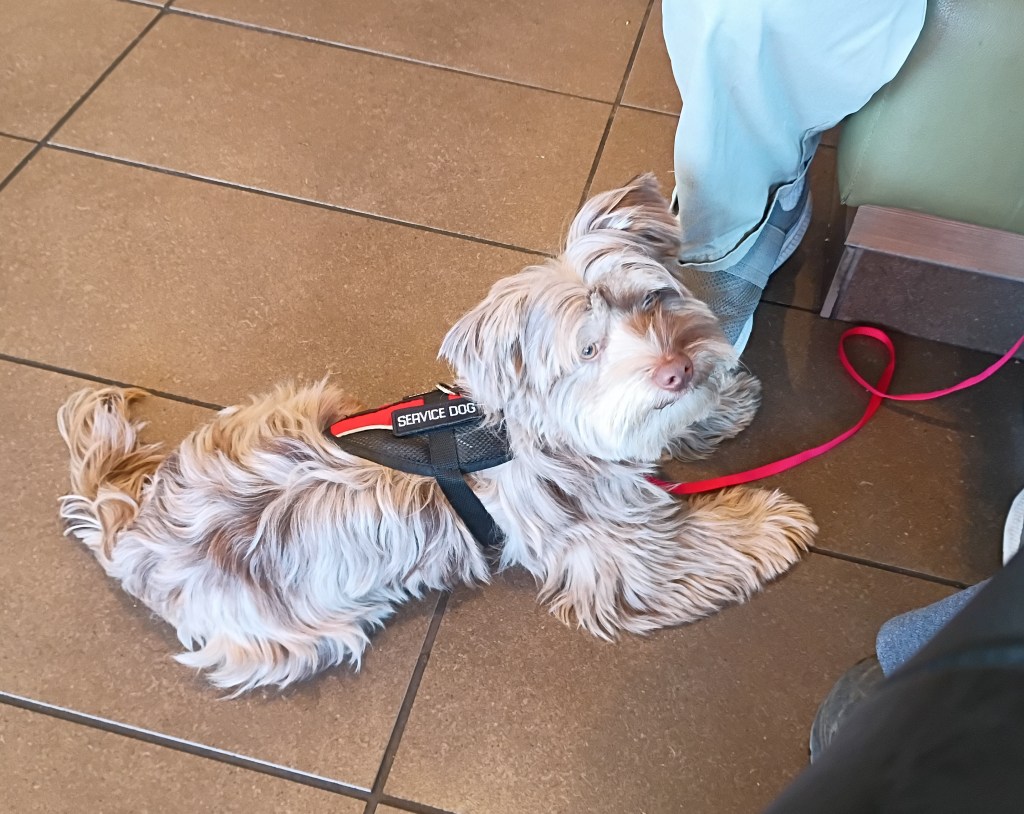
On this page you will find videos of Simba’s training at a Farm Store and McDonald’s restaurant.
DROP THE LEASH – stop and recover
HEEL TIGHT / CLOSE to Handler
RESULT of TIGHT HEELING lesson (video above)
WAITING IN LINE at McDonalds (with lots of sights and sounds)
THE CONDIMENT AND DRINK STATION
Simba needs to listen to and obey verbal commands (without the handler’s assistance, intense focus, leash tugs or other cues) because, in this case, the handler is carrying a tray with drinking cups.
REMAINING CALM when there’s an unexpected SNAFU at the Drink Station (and the handler’s attention cannot be fully on Simba’s behavior.)
These sorts of real world distractions are going to happen routinely in a Service Dog Handler’s life with her dog. That’s why, during TRAINING, teaching a very HIGH Standard of behavior is critical. But even more so, once we’ve trained a dog, we need to INSTRUCTING the dog’s HANDLER to maintain those training standards through teaching, coaching and lots of practice.
A dog’s behavior is a direct reflection of its relationship with its person – not merely a result of training with a specific person / trainer. That’s why our Handler Instruction is absolutely necessary – as much as the training we do with the dog.
A WELL TRAINED SERVICE Dog should be able to observe his surroundings (if/when the handler finds that acceptable) without losing his capacity to remain under self control and also check in with his handler frequently.
HOW DO YOU CORRECT A DOG? This is one of the most common questions we get as trainers. There is NO ONE answer. Why? Because every dog is going to present a different level of desire to break a standard depending upon dozens of different variables in any one specific situation.
I’ve posted a video at the end of this page that describes the entire process.
In this next video of Simba, you can see how the idea the “the correction should be equal and opposite of the dog’s unacceptable behavior” comes into play.
Because he had already learned the concept of “Leave it” in a variety of situations (toys, other dogs, food etc…), Simba didn’t try to quickly snatch the food that was dropped in front of him. Rather, he sniffed it.
Since Robert didn’t find sniffing the food acceptable, he followed up the warning words (leave it) with a collar check. The intensity of the correction matched Simba’s intensity and motivation to break the standard.
Many people will over-correct a dog in this situation. Why? Well new trainers can easily become frantic or over-reactive because they are just learning how to remain calm rather than feeling out of control of a situation.
Next, the exercise was repeated, and when Simba began to sniff the food, the handler simply gave the warning words (“leave it” in a calm tone) and you can see Simba’s choice to stop sniffing the food to avoid the potential correction for non-compliance. So, of course, no correction was given. Here again, new trainers will give the dog a correction when it’s not necessary. But, if the dog complies with the warning, he shouldn’t get the correction. We want our dogs to believe that if they listen to us, they can avoid getting a correction. That’s the MAGIC. We want the dog to learn that we are capable of keeping them from a negative experience if they listen to us.
Next, rather than dropping the food, it was slid into his space, and Simba chose to sniff, and did not comply to the “leave it warning,” so he received a collar check correction. This isn’t a sign that Simba hadn’t learned the meaning of the warning “leave it.” The scenario was different. It wasn’t a dropped morsel, but rather it was pushed into his space. Those are totally different situations from the dog’s point of view.
Part of training requires that the dog learns that “sit means sit no matter what” and “leave it” means don’t sniff or grab it, “regardless of what is placed in front of you, and how.
Many new handlers get frustrated when their dog appears to “disobey sometimes” and not others. Often, that’s because, before the dog came to us for training, he had learned that his owner wasn’t consistent or reliable regarding expectations. And, that’s why we need to present what appears to be the “same lesson” in a variety of locations and circumstances to help him to generalize “this warning applies everywhere, not just some places or some times.” He needs to learn that a good leader will be consistent and fair and reliable.
INCREASING the temptation:
Here is that video about HOW TO CORRECT A DOG that I promised.


Leave a Reply